The AI disclosure paradox: Why transparency alone won’t build trust
Jun 29, 2026
AI Strategy

AI adoption is accelerating across Canadian marketing, but trust is not keeping pace. Over two CMA AI committee sessions this spring, we examined what the academic evidence says and what it means in practice.
The numbers frame that gap. KPMG reports that 93 per cent of Canadian businesses are using or piloting AI, yet only two per cent see measurable returns. Canada ranks 42nd of 47 countries for trust in AI systems. PwC finds that 72 per cent of organizations call responsible AI a priority, while 36 per cent still have no dedicated governance function. The shortfall is less a technology problem than a credibility one.
Canada’s adoption gap
Canada’s recently released national AI strategy reinforces the same tension: trust is treated as the foundation for adoption, yet business uptake remains uneven, particularly among SMEs.
The challenge is no longer technical. It is whether organizations, and their customers, are ready to trust and use AI in practice.
The disclosure paradox
Our instinct as marketers is that transparency builds trust. The research complicates that. Schilke and Reimann ran 13 pre-registered experiments with more than 3,000 participants and found that disclosing AI use reduced trust in every framing they tested. The mechanism was perceived legitimacy (Schilke & Reimann, 2025). In a separate set of 16 experiments with more than 27,000 participants, AI-labeled creative writing was consistently devalued, even when described as human and AI collaboration. Here the driver was perceived authenticity (Raj et al., 2025). A third study found that AI-generated marketing can trigger moral disgust, a visceral response rather than a reasoned one (Kirk & Givi, 2025).
Three studies, three mechanisms, one uncomfortable conclusion: this is not a copywriting problem. Better wording will not fix it. Yet concealment is worse. IBM reports that 82 per cent of Canadians would trust a brand less if it had hidden its AI use (IBM, 2026). Disclosure carries a cost, and so does silence.
In short, disclosure can reduce perceived authenticity, but hiding AI use damages trust more.
What moves the needle
The evidence points to four levers:
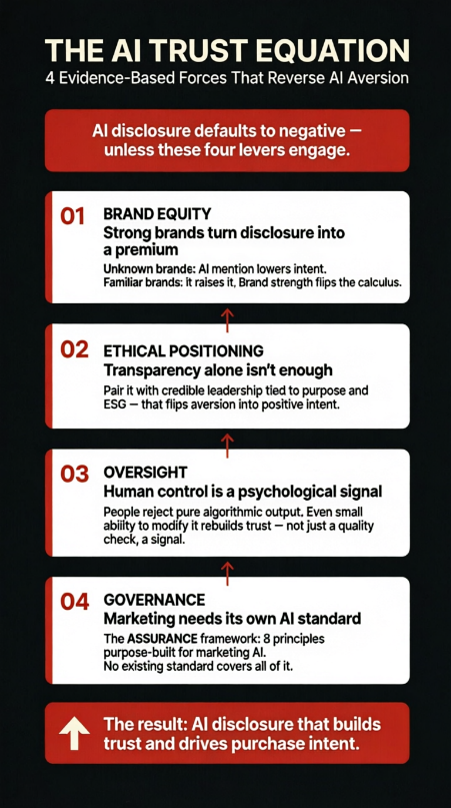
- First, brand equity. For unknown brands, mentioning AI lowered purchase intent; for familiar brands, it raised it. A strong brand and an AI-literate audience can turn disclosure from a tax into a premium (Pierre et al., 2026).
- Second, ethical positioning. Transparency alone does not buffer AI aversion, but pairing it with credible leadership tied to purpose and ESG can flip the response toward positive intent (Sands et al., 2025).
- Third, oversight. People reject algorithmic output unless they can modify it, so even small human control rebuilds trust. Oversight in this sense is a psychological signal, not just a quality check (Dietvorst et al., 2018).
- Fourth, governance built for marketing. Hermann and Puntoni propose an eight-principle framework they call ASSURANCE, and note that no major existing standard covers all of it (Hermann & Puntoni, 2025).
The thread running through all four is that compliance is the floor, not the ceiling. Governance builds trust only when it is visible in how campaigns are designed, reviewed and approved, not just documented. Established brands may benefit from selective disclosure; emerging brands may need to lead with human creativity. Even minimal human review signals control and can materially improve trust.
What we heard in the room
Three themes stood out as the discussion sharpened what the research taught us.
Governance starts internally. Before anything reaches a customer, teams need AI literacy, clear oversight workflows and an agreed view on where the disclosure red line sits. Does a grammar tool count? Does a fully generated draft? Most organizations have not yet defined clear thresholds for when AI use should be disclosed.
Context is not in our control. Even careful AI use lives in a feed crowded with slop, astroturfing and fake testimonials. Consumer perception gets coloured by the worst actors, not the most responsible ones.
Consumer trust is shaped as much by bad actors as by responsible brands.
The strongest use is augmentation. Committee members described AI as most valuable when it challenges thinking rather than produces the final output, and when it handles back-end work rather than front-end creative where audiences can feel a brand promise being broken. Trust also rises when people experience real value: Edelman found a gap of 37 points between those who had felt AI help them and those who had not (Edelman, 2025).
In closing
Marketers are looking for applied direction: examples of acceptable and unacceptable use, clear data boundaries, defined human review points and risk-based use cases.
A practical approach is to calibrate disclosure based on two factors: (1) your brand’s existing trust equity and (2) your audience’s familiarity with AI. The wider opportunity is narrative. Marketers are communicators by trade.
If we do not define what responsible AI use looks like in practice, others will, often shaped by the least responsible actors.
References
- Canada’s National Artificial Intelligence Strategy: AI for All
- Dietvorst, B. J., Simmons, J. P., & Massey, C. (2018). Overcoming algorithm aversion: People will use imperfect algorithms if they can (even slightly) modify them. Management Science, 64(3), 1155-1170. https://doi.org/10.1287/mnsc.2016.2643
- Edelman. (2025). Flash poll: Trust and artificial intelligence at a crossroads. https://www.edelman.com/trust/2025/trust-barometer/flash-poll-trust-artifical-intelligence
- Hermann, E., & Puntoni, S. (2025). Generative AI in marketing and principles for ethical design and deployment. Journal of Public Policy & Marketing. https://doi.org/10.1177/07439156241309874
- IBM. (2026). Canada's AI moment: Five trends redefining business confidence, speed and trust in 2026. https://canada.newsroom.ibm.com/2026-02-02-Canadas-AI-Moment-Five-Trends-Redefining-Business-Confidence,-Speed-and-Trust-in-2026
- Kirk, C. P., & Givi, J. (2025). The AI-authorship effect: Understanding authenticity, moral disgust, and consumer responses to AI-generated marketing communications. Journal of Business Research, 186. https://www.sciencedirect.com/science/article/abs/pii/S0148296324004880
- KPMG. (2026). Beyond AI adoption: Turning Canada's AI momentum into measurable returns. https://kpmg.com/ca/en/insights/2026/03/beyond-ai-adoption.html
- Pierre, L., Wang, J., & Zambrano Rodriguez, V. C. (2026). Exploring the influence of 'artificial intelligence' mentions in advertising and persuasion knowledge on brand skepticism, perceived manipulativeness, and purchase intention. Journal of Marketing Communications. https://doi.org/10.1080/13527266.2025.2609808
- PwC Canada. (2026). Trust in AI report. https://www.pwc.com/ca/en/media/release/pwc-canada-2026-trust-in-ai-report.html
- Raj, M., Berg, J. M., & Seamans, R. (2025). The artificial intelligence disclosure penalty: Humans persistently devalue AI-generated creative writing. Journal of Experimental Psychology: General. https://michiganross.umich.edu/news/readers-less-favorable-toward-ai-generated-creative-writing-berg-research-finds
- Sands, S., Demsar, V., Ferraro, C., Wilson, S., Wheeler, M., & Campbell, C. (2025). Easing AI-advertising aversion: How leadership for the greater good buffers negative response to AI-generated ads. International Journal of Advertising. https://doi.org/10.1080/02650487.2025.2457080
- Schilke, O., & Reimann, M. (2025). The transparency dilemma: How AI disclosure erodes trust. Organizational Behavior and Human Decision Processes, 188, 104405. https://doi.org/10.1016/j.obhdp.2025.104405
Authors:
Kevin Floether MCM, MCPRS, APR, CM | Director, Marketing & Communications | Chartered Business Valuators Institute
Tiffany Wong, JD, CIPP/E, AIGP | Director, Enterprise AI Governance – AI Compliance and Oversight | CIBC
LATEST PERSPECTIVES
|VIEW ALL