CX governance: the missing link between strategy and execution
Kerry Irvine
VP, Marketing | Retail & Wealth Distribution & Product Innovation TD Bank Group
Aug 04, 2026
Customer experience Thought Leadership

Why customer experience depends on how decisions get made
Customer experience (CX) has become a priority for most organizations. Leaders talk about being customer-first. Teams invest in journey maps, customer metrics, dashboards, service design and voice-of-customer programs.
And yet, the experience customers receive can still feel fragmented.
That’s because customers don’t experience an organization as departments, channels, products or platforms – they experience it as a journey. But inside many organizations, decisions are still made by function, channel or line of business.
This is where CX strategies often stall.
The issue isn’t always a lack of insight, commitment or measurement. More often, it’s that organizations have adopted the language of customer-centricity without changing how customer-impacting decisions actually get made.
McKinsey has noted that embedding customer experience into the organization and operating model is a critical enabler of CX transformation, requiring cross-functional collaboration, clear processes and target-setting aligned to CX ambitions. Gartner similarly describes CX governance as a means to help business partners adopt consistent CX principles in decision-making.
Put simply: if decision-making doesn’t change, customer experience usually won’t either.
CX isn’t just a function
Many organizations treat CX as a team, a toolkit, a reporting function or a group of subject matter experts brought in for input. That work matters, but it isn’t enough.
CX needs to shape how priorities are set, how trade-offs are made and how customer-impacting decisions move through the organization. This is the difference between having a CX function and having a CX operating model.
CX function | CX operating model |
Identifies friction | Identifies who fixes it |
Maps a journey | Governs how it's managed |
Reports on sentiment | Decides on action |
Customers rarely feel the impact of a strategy document. What they do feel is the impact of operational decisions – what gets prioritized, funded, simplified, delayed or escalated.
What CX governance really means
CX governance is often misunderstood as even more processes or even more approvals. Done well, however, it should create clarity, not added bureaucracy.
CX governance is the operating system that helps an organization design, run and improve customer experiences across channels, products and platforms. It defines decision rights, approval paths and evidence standards for customer-impacting change, and it applies to both people systems and technology systems.
In practical terms, CX governance answers a critical question: how are customer-led decisions made when trade-offs arise?
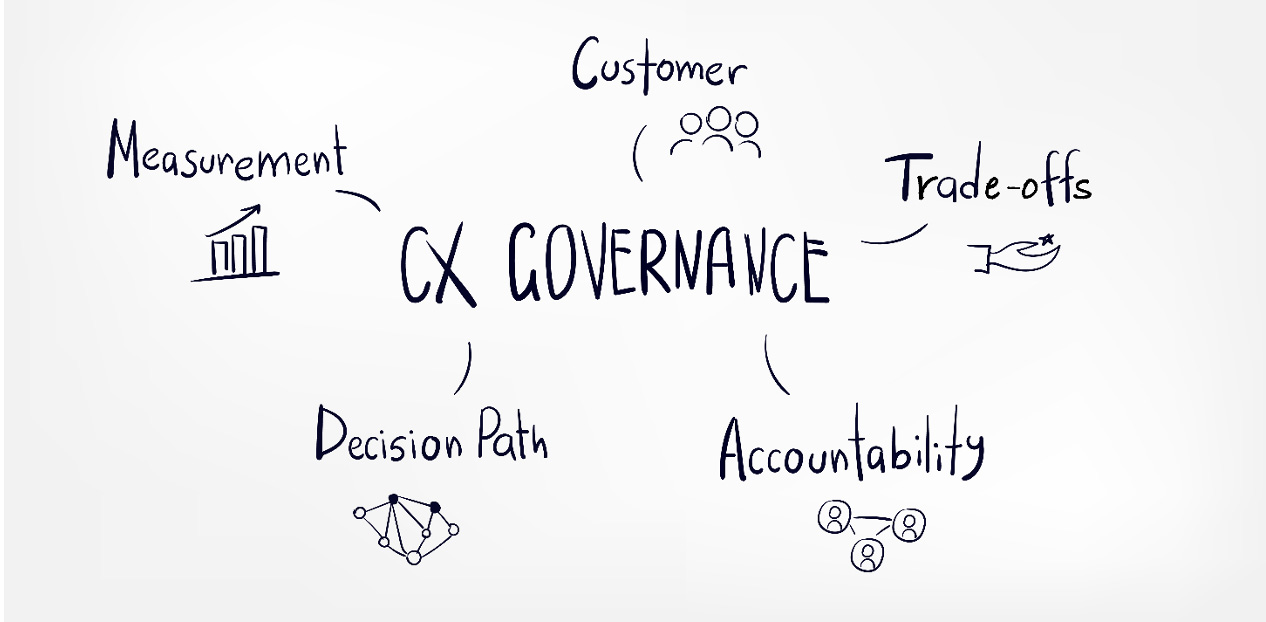
Good governance helps teams weigh trade-offs before decisions are made.
That question matters because most meaningful CX decisions involve trade-offs. A faster launch may create customer confusion. A lower-cost solution may increase complaints. A simpler customer process may create operational complexity. A more personalized experience may require stronger privacy and risk controls.
Without governance, those decisions can default to cost, speed, risk or whichever function owns the immediate task. Governance helps ensure the customer impact is considered before decisions are made, not after problems arise.
The risk of influence without authority
One of the harder truths about CX is this: you can’t be accountable for CX without some level of authority over the decisions that shape it.
Many CX teams are asked to improve the experience, but their role is largely advisory. They surface insights, facilitate journey work, report on metrics and recommend improvements, but when decisions become difficult, the final call often sits elsewhere.
That doesn’t mean CX teams should own every decision. They shouldn’t. But organizations require clarity on where CX has decision rights, where it has influence, where it can escalate, and which customer-impacting changes require a formal customer lens.
Forrester has noted that journey-centric organizations need new operating models, roles, responsibilities and governance structures to drive accountability and scale impact. Without that structure, journey maps can remain static artifacts instead of tools that guide delivery, prioritization and measurement.
Metrics are not governance
Metrics are essential, but they’re not a substitute for governance.
A dashboard may show friction. Governance determines who owns the fix.
A complaint trend may reveal a systemic issue. Governance determines whether it gets escalated.
A low satisfaction score may raise concerns. Governance determines whether the organization investigates the root cause or simply monitors the number.
This is where many organizations miss an opportunity. They review metrics, but don’t always create the authority, forums or accountability needed to act on them. Over time, this can lead to inconsistent service outcomes, poor complaint handling and teams optimizing the score rather than the experience.
What effective governance includes
Effective CX governance doesn’t need to be overly complex, but it does need to be explicit.
At minimum, organizations need:
- Accountability models: who owns the customer outcome, not just the task?
- Decision forums: where are trade-offs discussed and priorities set?
- Escalation paths: what happens when teams can’t resolve a conflict?
- Measurement authority: who decides which metrics matter and what action should follow?
These elements create a common language across the organization. They help teams understand when to engage CX, what evidence is needed and how customer impact should be weighed alongside cost, speed, risk and operational feasibility.
Start with one journey
Organizations don’t need to solve CX governance everywhere at once. A practical starting point is focusing on one high-impact, cross-functional journey where the customer outcome depends on multiple teams working together.
From there, leaders can ask:
- What customer outcome are we trying to improve?
- Which teams influence that outcome?
- Where do decisions currently slow down or fragment?
- Who has the authority to make trade-offs?
- What evidence should guide the decision?
- How will we know if the experience is improving?
The goal is not to create more meetings. It is to improve decision speed, consistency and customer outcomes.
It's time to ask a new question
For years, organizations have asked: how do we improve customer experience?
That question still matters, but a better one may be: how are customer-led decisions made when trade-offs arise?
That question moves CX from aspiration to action. It pushes organizations to look beyond dashboards, journey maps and good intentions, and ask whether CX is truly embedded in how work gets prioritized and delivered.
Because ultimately, customers don’t feel our intentions. They feel our decisions.
Sources:
- McKinsey, How the operating model can unlock the full power of customer experience, June 2022
- Gartner
- Forrester, Making Journey Management Work: The Roles, Teams, And Processes That Drive CX Success, October 2025
- Forrester, Customer Journey Management In 2026: From Maps To Measurable Impact, January 2026
Author:
Kerry Irvine, VP, Marketing, Retail and Wealth Distribution and Product Innovation, TD Bank Group
Contributor:
Erin McKeever, Director, Marketing Innovation, Kruger Products Inc.

LATEST PERSPECTIVES
|VIEW ALL
Know What You're Made Of
Marketing is changing faster than job descriptions can keep up. The same is becoming true of careers: the skills and ...